
Dialysis Access
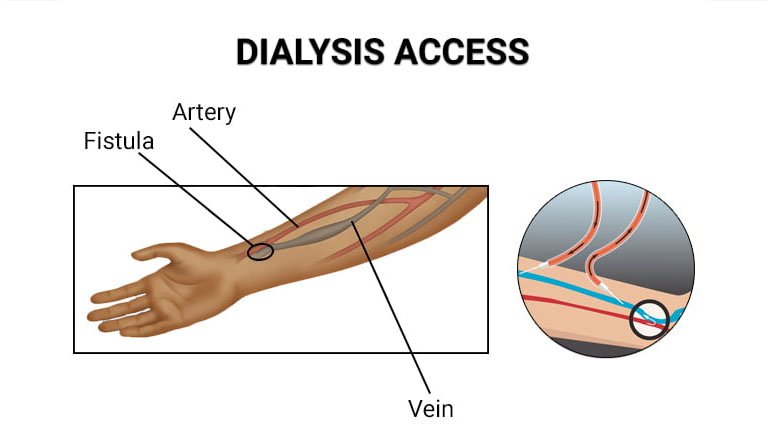
Dialysis Access
Dialysis access is an important part of long-term care for patients with kidney failure who require hemodialysis. A reliable vascular access provides a safe and effective pathway for blood to be removed from the body, filtered through the dialysis machine, and returned to the bloodstream.
Dialysis access may be created, evaluated, maintained, or treated depending on the patient's kidney function, dialysis requirements, vascular anatomy, and overall health. Proper planning and regular monitoring can help maintain access function and reduce complications that may interrupt dialysis treatment.
Types of Dialysis Access
- Arteriovenous (AV) Fistula
- Arteriovenous (AV) Graft
- Hemodialysis Catheter
- Tunneled Dialysis Catheter
- Temporary Dialysis Access
- Revision of Existing Dialysis Access
Conditions & Access Problems We Manage
Dialysis access may require evaluation or treatment when patients experience:
- Poor or Reduced Blood Flow
- Access Narrowing (Stenosis)
- Access Thrombosis or Blood Clots
- Difficulty During Dialysis
- Repeated Dialysis Machine Alarms
- Swelling of the Access Arm
- Bleeding from the Access Site
- Access Infection
- Aneurysm or Pseudoaneurysm
- Failing or Dysfunctional AV Fistula or Graft
Comprehensive Evaluation & Treatment
Evaluation of dialysis access may include a detailed clinical examination along with vascular imaging when required. Doppler ultrasound can help assess blood flow, narrowing, clot formation, and other abnormalities affecting the access.
Depending on the underlying problem, treatment options may include medication management, endovascular procedures, angioplasty, thrombectomy, or other minimally invasive techniques. In selected cases, surgical revision or creation of a new dialysis access may be considered.
AV Fistula & AV Graft Care
An AV fistula or graft requires regular monitoring to ensure that it continues to provide adequate blood flow for dialysis. Early evaluation of changes such as reduced dialysis flow, swelling, prolonged bleeding, or difficulty with needle placement may help identify access problems before they become more serious.
When clinically appropriate, procedures may be performed to restore or improve access function and help maintain reliable dialysis treatment.